
Sometimes, I want to share so much about plants that it’s hard to pick a place to start. But with the White Fusion (commonly known as the White Fusion Peacock Plant), it was easy—no doubt about it. What do you love most about your plant? Let me guess… those beautiful white patches on its leaves, right? So let’s kick things off there.
Variegation is that striking characteristic that makes the White Fusion look S-P-E-C-T-A-C-U-L-A-R. However, it does come with some implications we should all keep in mind.
Why Variegation Matters
Do you know why variegation occurs? In short (very short), variegated leaves have white areas because they lack chlorophyll.
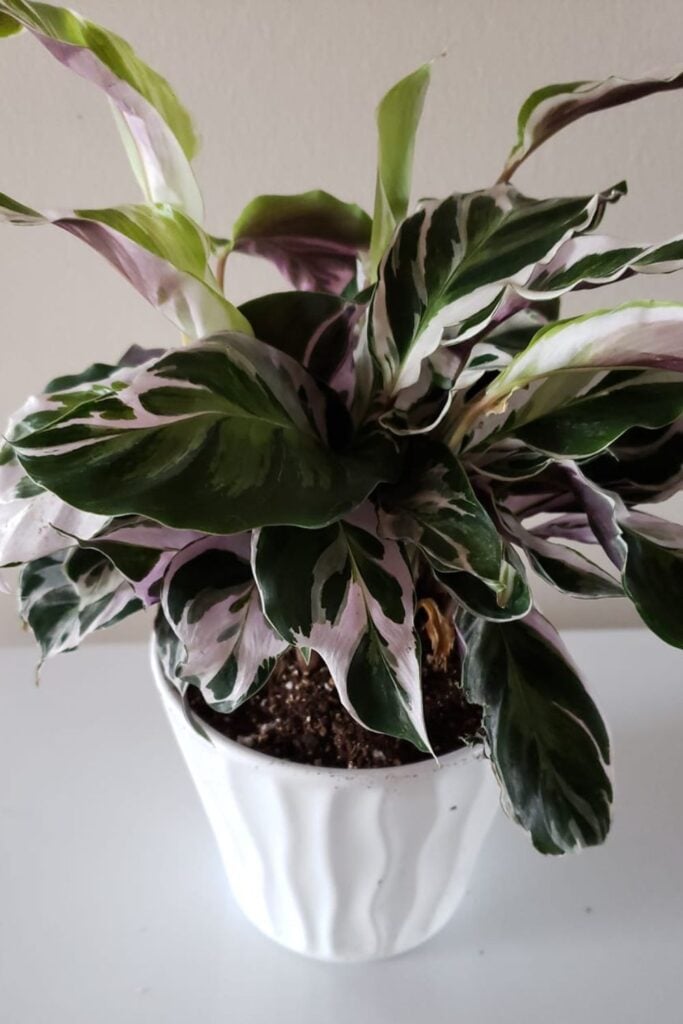
As you might recall, chlorophyll is the pigment responsible for absorbing light energy during photosynthesis. So, as you can imagine, the plant can’t photosynthesize in the white areas of its leaves.
Does this limit the plant? I’m afraid so. Variegated plants have less leaf surface for photosynthesis, so they need more light compared to non-variegated varieties.
Essential Calathea White Fusion Care Tips at a Glance
I’m giving you a quick rundown of White Fusion care here. Want more info? Keep reading for the full details.
- Light: Needs bright light, but no direct sun. Why? Because direct sunlight can create leaf spots. Place it near a window with filtered or indirect light, or behind a sheer curtain.
- Watering: Water before the soil completely dries out. How often is that? Possibly two or three times a week in summer and once a week in winter.
- Humidity: Almost as important as watering. It needs about 60–70% relative humidity. If you want to avoid brown spots on the leaves, use a humidifier.
- Pests: I don’t usually talk about pests because most of my plants don’t get severely infested, but for the White Fusion, get a good insecticide—you’ll need it!
Light, Placement, and Temperature for White Fusion
If you’re still with me, it means you’re ready to give your Calathea the best. Let me warn you: caring for this plant can be a wild adventure.
I recommend it for seasoned plant lovers who’ve got some experience with indoor jungles. But if you’re brave and still want one, here are my top tips:
Since this plant is variegated, it has a lower capacity for photosynthesis than “non-variegated” Calatheas. In other words, it needs more light than a typical Calathea.
A great spot is near a window with bright, indirect light (or a sheer curtain to block direct sun, which is no good for either of you!).
As for temperature, these plants thrive in warm climates and can’t handle extremes (not too hot, not too cold).
They often struggle most in summer, especially those scorching summers in many parts of the U.S. that can go above 100 °F [38 °C]. They also dislike cold weather; once temperatures dip below about 65 °F [18 °C], they start to suffer.
Pro Tips for Summer
- Keep a close eye on watering and humidity. The only way for it to endure high heat is by maintaining higher ambient humidity so it won’t dehydrate. Misters and humidifiers definitely help.
- Placing it in the coolest room in your home can also work wonders.
Pro Tips for Winter
- If your home stays above 65 °F [18 °C] indoors, you won’t have much trouble. But if it drops below that, mulch or cover the soil surface with materials like coco coir (such as this coco coir) or expanded clay pebbles (like these LECA clay pebbles) to keep the roots insulated from temperature fluctuations.
- In winter, the soil stays moist longer, so water less frequently. Always check the soil before watering again.
Mastering the Art of Watering for Calathea White Fusion
Watering is an art, and no matter how many guidelines I give, the best method is to water “by feel.” That means observing your plant and deciding if its soil is dry or how plump or droopy the leaves look.
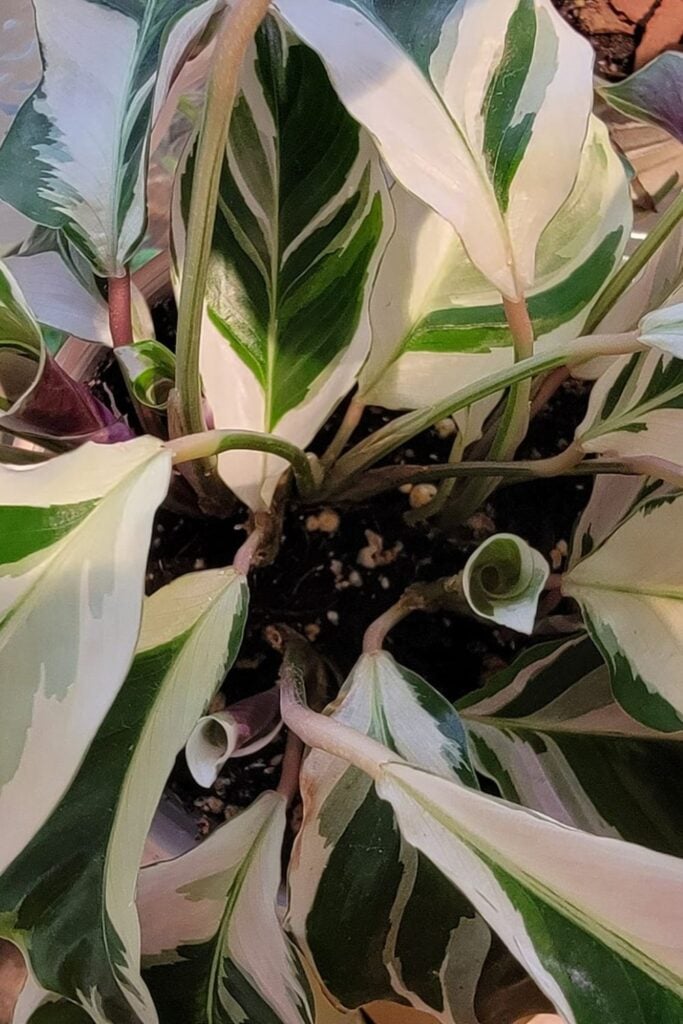
Then you choose whether to water right away or wait a few more days. I know guidelines help, so here’s what I do:
- Summer: Don’t let the soil completely dry out between waterings. Pick a watering day (or two) each week, and check the soil every couple of days. Once you see how many days it takes to dry, you’ve found your watering rhythm. I personally end up watering about two or three times per week during summer.
- Winter: Because of lower temperatures, your soil stays moist longer, so you can space out your waterings. Use the same process: water, then monitor how many days it takes for the soil to dry.
A common issue is brown spots on the leaves, typically caused by dehydration. Calatheas are fussy about watering and lose water through their leaves.
Those brown spots are a result of that moisture loss. To prevent browning, aim for high humidity (above 60%) to offset the leaves’ transpiration. This way, you help the plant keep its tissues hydrated.
Let me tell you something that all Calathea enthusiasts must accept: having perfectly pristine leaves is tough unless you live in a very humid environment.
Don’t be disappointed if your plant has some brown edges. They’re just like us—imperfect. Love them anyway: they’re temperamental, complicated, and sometimes get crispy edges.
Battling Pests: A Persistent Challenge for White Fusion
I don’t say this often, but White Fusion attracts pests like candy attracts kids (or like garden centers attract me). The most common culprits are spider mites (which often appear as white dots) and mites that look like tiny black spiders.
The problem? These pests are minuscule and hide on the underside of leaves, making them super hard to detect. It’s crucial to inspect the leaf undersides whenever you water, because you’ll probably find a new surprise every month or so.
When these pests show up, you’ll notice small yellowish or light-green spots on the leaves. Those spots have tipped me off more than once that something was up.
And about eliminating them? Honestly, I haven’t found a foolproof solution. They keep coming back. The best advice I can offer is to invest in a triple-action houseplant insecticide (such as this one on Amazon) and stock up on patience.
I hope this post on caring for Calathea White Fusion helps you out! If you want to share your own experiences with yours, don’t hesitate to leave a comment.


