
If someone gifted you a Christmas cactus or you managed to snag one yourself—but it won’t bloom or flowers in a strange way—don’t panic or assume something’s wrong with the plant.
It’s entirely possible you’re not dealing with a Christmas cactus at all, but a completely different species.
The Christmas cactus, also known by its genus name Schlumbergera, earned that name thanks to French botanist Frédéric Schlumberger, who grafted it onto a classic spiny cactus.
Instead of dying, the plant thrived and burst into bloom—proof positive it belongs to the Cactus family.
You’ll also hear it called the Thanksgiving cactus, “holiday cactus,” or “December cactus.”
It’s especially prized for its beautiful, abundant blooms just when most houseplants are in winter “hibernation”—from late November through January. In its native land, it’s even seen as a New Year’s symbol.
But if your plant looks healthy yet never flowers on schedule—or blooms differently than others—it’s worth confirming whether it’s truly a Christmas cactus. After all, it has close cousins that can fool even the most seasoned gardener.
Which Plants Look Like Schlumbergera
Several members of the cactus family resemble Schlumbergera in appearance. Among them:
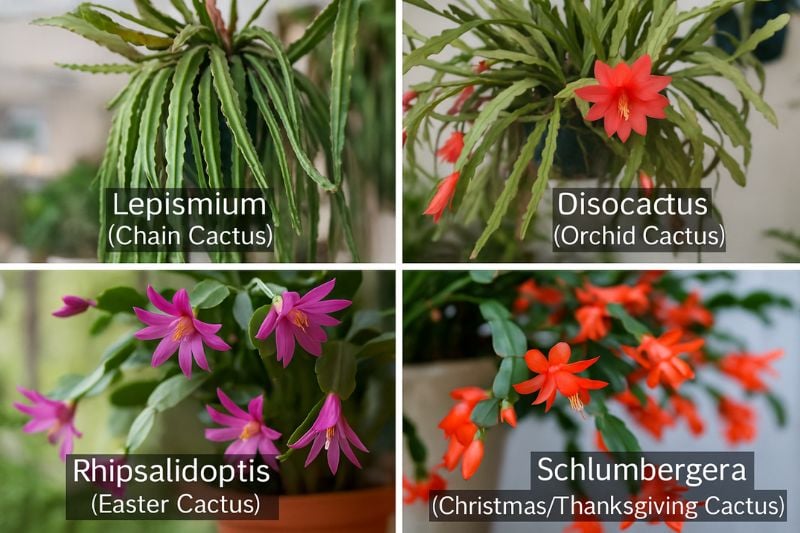
- Lepismium – This plant’s stems are divided into flat segments too, but its “leaves” are longer, and it blooms from May through September. It’s more often grown as a trailing houseplant, like an Orchid Cactus.
- Disocactus (Aporocactus) – Known as Chain Cactus, it features thin, wavy-edged stems with spines. Its unsegmented shoots can reach up to 16 ft 5 in [5 m] long, and it blooms from February through August.
- Rhipsalidopsis (Easter Cactus) – The most famous “double” of the Christmas cactus, often called Easter cactus. Even experienced growers can struggle to tell them apart.
Why Christmas Cactus and Easter Cactus Get Mixed Up
Rhipsalidopsis (Easter cactus) and Schlumbergera share a striking resemblance. Some gardeners don’t even notice the difference and assume the plants growing side by side are the same.

They also share a tropical rainforest origin in Latin America—and both are epiphytic cacti, meaning they naturally perch on tree branches for support.
Both plants have stems made up of small segments forming a sprawling bush, with blooms emerging at the tips of the branches.
But despite these similarities, they belong to different genera (Rhipsalidopsis vs. Schlumbergera) and aren’t varieties of the same species.
Their care needs also differ at certain times of the year, so to give your cacti the best life on your windowsill, first pin down which one you have. Once you take a closer look, you’ll see the differences jump out.
Key Differences Between Christmas Cactus and Easter Cactus
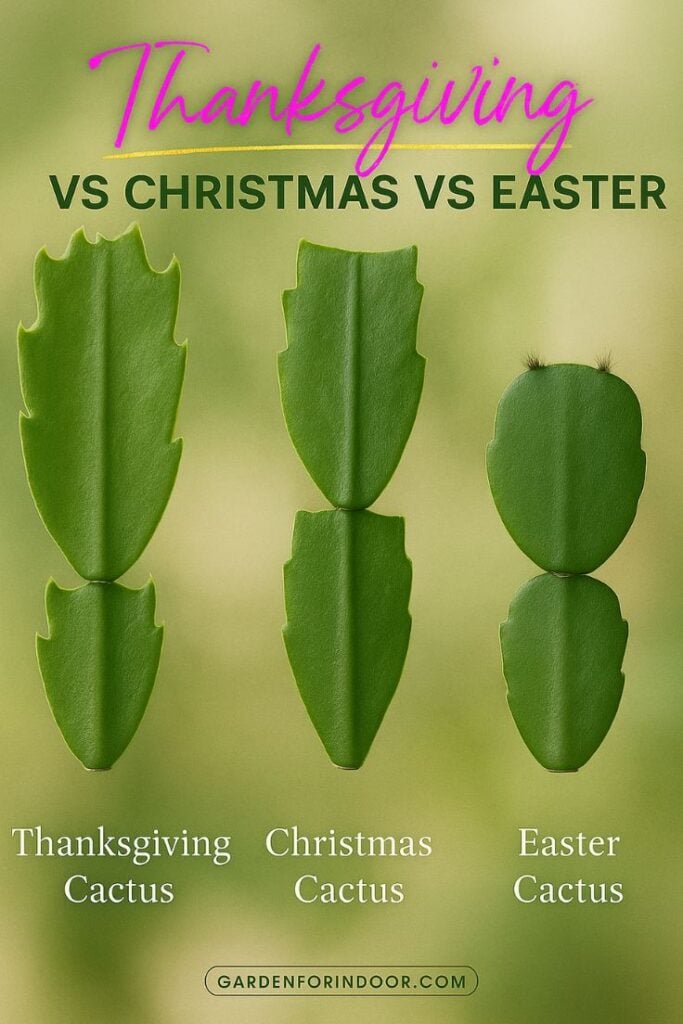
- Stem segments – Both plants have stems of linked segments, but the shapes differ. Christmas cactus segments have jagged teeth along the edges, while Easter cactus plates are longer, smooth, rounded, and sometimes edged with a reddish tint.
- Bud placement – During bloom, Easter cactus produces buds at both the tips and the sides of segments, making it look extra festive. Christmas cactus, on the other hand, only flowers at the ends of its stems.
- Flower form – Christmas cactus flowers are two-tiered, elongated, and slightly asymmetrical, with rounded petals. Easter cactus blooms are symmetrical, star-shaped, single-layered, with straight, pointed petals.
- Bloom time – Christmas cactus flowers in winter—from late November through January—while Easter cactus bursts into bloom around Easter in April and stays decorative through May.
- Growth rhythm – After flowering, Christmas cactus enters a rest period of about a month before active growth resumes; Easter cactus, however, remains in an active growth phase for 3–4 months after blooming, then only later goes dormant.
Caring for Christmas Cactus vs. Easter Cactus
Since Schlumbergera and Rhipsalidopsis are closely related and both hail from similar wild habitats, their care in the home is almost identical. The difference is when you do each task, thanks to their distinct growth rhythms.

Neither plant likes direct sun. They prefer a neutral to slightly acidic, well-draining potting mix, plenty of water without soggy soil, and hate being moved around or placed near heaters when buds are forming.

Christmas Cactus Care
- Late fall to early winter (pre-bloom): Increase watering as the soil dries—about twice a week. Don’t touch or rotate the pot; the slightest stress can cause buds or open flowers to drop.
- Until March: Leave the plant alone. Once spring arrives, feed and repot if needed.
- Summer: Keep it at 68–73 °F [20–23 °C] with bright, indirect light, regular feeding, watering, and a warm shower now and then.
- Fall: Reduce watering and move to a cooler, shaded spot at around 59 °F [15 °C] for about two months—just enough rest before next winter’s bloom.
Easter Cactus Care
- Late fall to early winter (dormancy): Shift to a cooler, shaded area at 50–59 °F [10–15 °C]. Cut back on watering or even stop altogether. Let it rest until the end of winter.
- Spring (pre-bloom): Move to a warmer, brighter room and resume watering generously. As flowering approaches, empty the saucer under the pot to prevent excess moisture. Start feeding about a month before blooms.
- Summer: Maintain temperatures between 64–77 °F [18–25 °C], but watch out for heat stress. Continue feeding; alternate watering with occasional misting with warm water.
- Fall: Stop fertilizing and reduce watering to prepare for dormancy.
Now you know how to spot the difference between a Christmas cactus and an Easter cactus. If you bring both home, you’ll enjoy bright blooms from winter through spring—just be sure not to mix up which one needs what!


