Panicle Hydrangea, Bigleaf Hydrangea, Smooth Hydrangea, Groundcover Hydrangea, Oakleaf Hydrangea—no matter which of these beauties you grow on your property, with proper care, they’ll reward you each year with those lush clusters of white, blue, or pink blooms.
If you’ve followed my tips on cultivating hydrangeas, you probably already know all about their varieties, planting, watering, fertilizing, propagation, pruning, winter protection, and even ways to change the color of their flowers.
Today, though, I want to chat about common hydrangea diseases and how to handle them effectively.
In reality, not all gardeners run into these issues—hydrangeas are quite resilient and usually fend for themselves. Still, sometimes they do need a little boost. So let’s explore the causes, symptoms, and treatments of the most widespread hydrangea ailments.
Hydrangea Chlorosis
Chlorosis is a condition where plants struggle to produce chlorophyll in their leaves, reducing photosynthesis.
This non-infectious chlorosis can often sneak up on hydrangeas if their growing conditions aren’t quite right.
How to Recognize Chlorosis

You’ll notice the leaves becoming lighter or yellowing (like they’re “fading”) and possibly getting pale spots, while their veins remain darker.
Why It Happens
Several factors can trigger chlorosis:
- Excessively alkaline soil, which blocks iron absorption
- Hard water used for irrigation
- A lack of nutrients in the soil
- Too much compost or nitrogen-rich matter in the soil
- Metabolic disturbances
- Unfavorable weather conditions
How to Treat Chlorosis
It’s often tough to pinpoint the exact cause right away, so I usually start by reviewing the entire care routine:
- Use soft (rain) water for watering. Aim to water when the sun isn’t too intense.
- Give each hydrangea at least 5 gallons (19 L) of water per week so the soil never dries out.
- Address soil pH before planting and throughout the growing season. If the soil’s too alkaline, try mulching with peat moss, pine needles, or pine bark. You can also drench the soil with a solution of oxalic or citric acid (1 teaspoon [5 mL] per 0.8 gallons [3 L] of water).
- Provide balanced fertilization on a regular schedule.
To ward off chlorosis, irrigate and spray your hydrangeas with an iron-rich solution (such as ferrous sulfate) once every 10 days, mixing about 1.8 oz (50 g) per 2.6 gallons (10 L) of water. If the leaves have already started to lose color, you can do this every five days until they rebound.
Hydrangea Powdery Mildew
Powdery mildew is caused by microscopic parasitic fungi. Their spores get around easily via air, rainwater, or even your gloves or tools.
How to Spot Powdery Mildew
Look for patches on leaves and other green parts of the plant that appear dusted with a white, “flour-like” coating. This coating is actually the fungal mycelium. Once the spores mature, you’ll see droplets of moisture resembling dew.
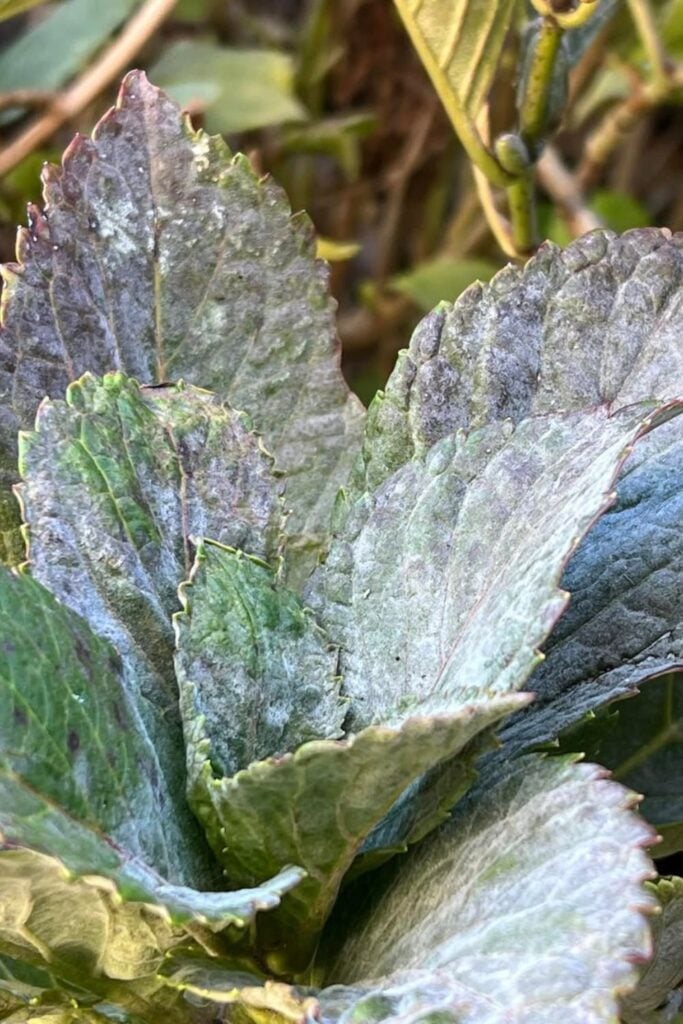
The disease typically spreads from the bottom up, first striking young or weakened plants. Affected leaves develop spots, then wilt and fall off. The hydrangea weakens and can die if the infection is severe.
High temperatures paired with sudden fluctuations in humidity, overcrowded plantings, overwatering, and excess nitrogen in the soil all set the stage for powdery mildew.
How to Treat Powdery Mildew
- Prune and destroy any infected plant parts as soon as you see symptoms. Get rid of plant debris, too.
- Watch your watering and feeding routine. Don’t overdo either.
- Fungicides can save the day if the disease progresses. You can use Bordeaux mixture (widely available in the U.S.) or a product like:
Follow each product’s label directions for dilution, then thoroughly spray the affected plants and the surrounding soil. It’s important to act quickly—powdery mildew can really take over if left unchecked.
Personally, I like to think of it as a little “garden vampire” and treat it before it drains the life out of my hydrangeas!
Downy Mildew (False Powdery Mildew) in Hydrangeas
Downy mildew is often referred to as “false powdery mildew” because its symptoms look quite similar.
On the upper side of the leaf, you’ll see discoloration—lightened spots—and at the same time, the underside of the leaf develops spots with a powdery coating. These spots can vary in color from yellowish or light gray to purple or reddish-brown.
You’ll usually notice the discoloration most vividly after a rainfall or heavy dew. On warm, sunny days, it may practically vanish. As the disease progresses, leaves dry out, turn dark, become brittle, and eventually drop off—even if the soil has plenty of moisture.
Downy mildew, like powdery mildew, is a fungal disease. The spores overwinter in plant debris and soil, then spread in spring via wind, rain, insects, and even contaminated garden tools (another good reason to disinfect them regularly). Cool, damp weather and sudden temperature shifts (often in early spring or fall) create the ideal environment for an outbreak.
How to Combat and Prevent Downy Mildew
- Practice Good Plant Care: Follow proper cultivation guidelines, and when cool, rainy weather sets in, reduce watering and keep an eye on humidity levels. Promptly remove and destroy plant debris.
- Sanitize and Prune: Carry out timely pruning as soon as you spot the first symptoms. Get rid of infected parts to stop the disease from spreading.
- Fungicide Treatments: At the first sign of infection, spray your hydrangeas with fungicides.
Carefully follow the label instructions for each product, and spray the affected leaves as well as the surrounding soil. Taking action at the first hint of trouble can save you from a full-blown outbreak!
Rust in Hydrangeas
Rust is a fungal infection whose severity depends on your region’s climate and how carefully you follow proper growing methods.
The culprits behind rust are microscopic parasitic fungi of the rust family, which are found worldwide. The spores overwinter on infected plant debris, and some types can also survive in the soil or plant roots. In spring, rain washes the spores into the soil, and wind or insects carry them to new hosts.
Any mechanical damage (like wounds from pests or pruning cuts) can give the fungus an easy entry point into a plant’s above-ground parts—leaves, stems, or even flower buds.
Once the spores settle in, they produce mycelium that damages cell walls and releases toxins, weakening the plant.
How to Recognize Rust
Come spring, look at the underside of your hydrangea leaves (and sometimes on stems, petioles, or buds). If you see discolored spots and yellow-orange or reddish-brown bumps, these are clusters of spores.

In time, the infected leaves and stems may turn yellow, curl up, dry out, and fall off. During summer and into early fall, you might notice darker (rust-brown) spots forming.
How to Combat Rust
- Early Stages: If you catch it quickly, prune out the infected shoots and remove any diseased leaves. Then treat it with biofungicides.
- Widespread Infections: If the disease has taken over, switch to stronger treatments. You can use:
- Syngenta Daconil Fungicide
- 1% Bordeaux mixture is often replaced by commercial copper-based solutions like the Bonide product above
- Bonide Infuse Systemic Fungicide
Apply the first treatment as soon as you notice symptoms. You can repeat the spraying after one or two weeks, following each label’s guidelines.
For prevention, keep the area weed-free, avoid crowding your hydrangeas, promptly remove and destroy plant debris, reduce watering when cold, wet weather sets in, and prune for good air circulation at the first sign of any disease.
Other Possible Hydrangea Ailments
Hydrangeas can also occasionally suffer from Cercospora leaf spot, Septoria leaf spot, Alternaria, Fusarium, and both gray and white rot.
In the vast majority of cases, these diseases gain the upper hand in unfavorable weather conditions and when hydrangeas are grown improperly.
If you don’t want to spend time and energy on lengthy treatments, take a moment to study the best cultivation practices before introducing any new hydrangea to your garden. A little know-how goes a long way in preventing these fungal troublemakers—and keeping your flowers looking vibrant and healthy!