
Croton (commonly called “Joseph’s Coat” or by its botanical name Codiaeum) is part of the Euphorbiaceae family. Among gardeners, the name “Croton” is more widely used than its Greek-derived scientific name “Codiaeum,” which means “head.”
No one is entirely certain what the word “Croton” actually signifies; it might come from the name of a town in southern Italy—where Pythagoras once founded his school—or possibly from a local dialect meaning “shrub.”
This plant’s natural range spans several Pacific Islands, northern Australia, Southeast Asia, and parts of India. Depending on the source, the genus may include anywhere from 17 to 1,200 species, but only Codiaeum variegatum (the variegated croton) and its hybrids are typically grown indoors.
It’s considered one of the most stunning foliage houseplants out there, and thanks to its compact size, it can be the star of any room without taking up too much space.
In some cultures, this houseplant is said to protect the home from negative energy, making it a wonderful fit if you’re looking to add both beauty and good vibes to your indoor space.

Brief Growing Overview
| Aspect | Details |
| Blooming Phase | Croton is prized for its decorative foliage, not its flowers. |
| Light Requirements | Before noon, give it bright, direct sunlight. After midday, provide either light shade or bright, diffused light. |
| Temperature Range | In summer, aim for 68°F to 72°F (20°–22°C). In winter, make sure it stays above 61°F (16°C). |
| Watering Schedule | Water regularly, but keep it moderate. Avoid letting the soil become completely dry or waterlogged. |
| Humidity Levels | Croton thrives with high humidity. Mist the leaves frequently, wipe them with a soft, damp cloth, and treat the plant to a shower once or twice a month. |
| Fertilizer Needs | From April to November, feed with a balanced, all-purpose fertilizer formulated for foliage plants every two weeks. During the rest of the year, fertilize once every four weeks. |
| Dormant Period | Winter is its resting time. |
| Repotting | Younger plants need repotting twice a year, while mature ones generally require it every couple of years. |
| Propagation Methods | Use seeds or propagate with stem or leaf cuttings. |
| Common Pests | Watch out for mealybugs, scale insects, nematodes, and spider mites. |
| Diseases | Gray mold (Botrytis) and sooty mold are potential issues. |
| Toxic Sap | The milky sap can be poisonous, so handle with care. |
Key Features of Croton
When grown indoors, Croton forms a small shrub with leathery leaves in a variety of shapes—long-lanceolate, asymmetrical, pointed, blunt-tipped, three-lobed, broadly oval, entire-edged, notched, and more.
New growth often emerges a paler greenish-yellow, gradually transitioning to vivid shades of red and green. This color shift can give the plant a gorgeous “fall foliage” vibe throughout the year. The veins in the leaves are typically very pronounced, which is a hallmark of all Croton types.
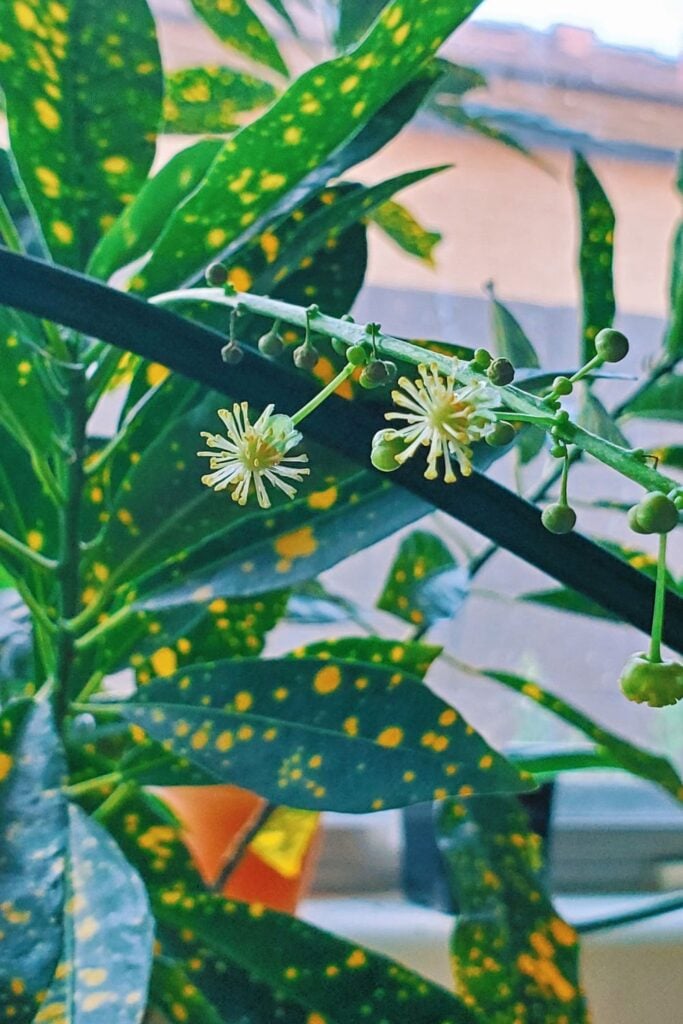
While Croton can flower, the blooms themselves are not particularly showy. They appear along drooping clusters that hang from the leaf axils, consisting of small, cream-colored flowers.
Caring for Croton Indoors
If you’ve ever wanted a plant to brighten your day and impress your friends, Croton might just be it—although it’s famously one of the more finicky houseplants around. Here are some important considerations:

Special Care Considerations
- Toxic Sap
The sap contains potent toxins that can trigger vomiting, diarrhea, or contact dermatitis. Always wear gloves when handling your Croton, especially for pruning or repotting. - High Humidity Is Key
Croton loves humidity. Regularly mist the leaves with water and gently wipe them down with a damp, soft cloth or sponge. During summer, I like to give my Croton a warm shower about once a month—just pop it in the bathtub or shower stall and let warm (not hot) water run over it. - Keep Away From Drafts
Croton is sensitive to drafts and won’t appreciate cold water when you’re watering. Room-temperature water is best. - Curious Leaf Shapes
Sometimes at the start of the growing season, Croton may produce leaves in unusual shapes. Scientists still haven’t pinned down the exact cause, but we do know that this plant is highly prone to genetic variation. That’s why breeders have been able to develop so many different hybrids. - Energy-Draining Flowers
Croton’s blooms are not exactly a showstopper, but they do consume a lot of the plant’s energy. If you’re not interested in saving seeds, remove the buds or flower stalks as soon as you see them. That way, the plant can direct its resources toward its gorgeous foliage instead.
Bright Light for Vibrant Croton Leaves
Croton needs plenty of bright sunlight, and direct sun won’t harm it if it’s during early mornings or late evenings.
During summer, it’s best to keep your Croton near a north-facing window, while in winter, a south-facing windowsill is recommended.
If you can, move it outdoors in the summer, but be sure to place it somewhere with bright, diffused light.
Keep Croton Cozy: Proper Temperature Range
When it’s warm outside, Croton feels right at home between 68°F and 72°F (20–22°C). During colder months, make sure the temperature doesn’t drop below 61°F (16°C).
Proper Watering for a Healthy Croton
It’s crucial to keep the potting mix slightly moist at all times. Avoid letting water pool around the roots, as this can lead to rot. To prevent issues, use well-settled or filtered water at room temperature—never cold.
Humidity Tricks Croton Will Love
Croton thrives in high humidity. Regularly mist the leaves or wipe them down with a damp sponge. In the summer, a warm shower is helpful, but be careful not to allow water to flood into the potting mix.
Feeding Schedule for Best Growth
From April through November, feed Croton every two weeks on pre-moistened soil with a balanced, water-soluble fertilizer designed for foliage plants. In winter, reduce feedings to once every four weeks.
Neat and Tidy: Pruning Your Croton
To keep the Croton’s crown attractive, pinch back young plants and prune mature ones. The first pinch should happen once the plant reaches about 6 inches (15 cm).
Afterward, pinch again each time new stems grow around 8 inches (20 cm). If you cut a mature plant, sprinkle the cut surfaces with sulfur powder or crushed charcoal to protect them.
Since Croton flowers aren’t very showy and sap the plant’s energy, remove flower buds or young flower stalks as soon as they form. Doing so ensures the leaves stay striking and the plant stays healthy.
Give It Room: Croton Repotting Guide
Young plants need repotting every six months, while mature Crotons require a new pot about every two years. Choose a container just 0.8 inches (20 mm) wider than the old one.
Once your Croton is in a pot with a diameter of about 10 inches (25 cm), you won’t need to repot anymore—just replace the top layer of soil each year.
Use a mix of equal parts river sand, peat, garden soil, and leaf mold (1:1:1:1). Repot via the transfer method: gently remove the Croton with its root ball intact and place it into the new pot.
Be sure the new container has a drainage layer that takes up at least a quarter of the pot’s volume.
Winter Care to Keep Croton Happy
When fall arrives, move your plant from the north-facing window to a south-facing windowsill. Reduce watering slightly, but keep the soil lightly moist.
Continue to mist and wipe the leaves, though you can cut back on how often you do it. A shower isn’t necessary during colder months.
Fertilize once every four weeks, although many experienced growers believe you can even skip fertilizing in winter with no ill effects.
Multiply Your Croton: Easy Propagation
Growing from Seeds
Indoors, Croton is rarely grown from seed unless you’re dealing with hybrids. Only use freshly collected seeds because they lose viability quickly.
Keep in mind that growing Croton from seed is a slow process, and new seedlings typically won’t carry the exact features of the parent plant.
Croton seeds are fairly large. Pre-soak them by placing them in hot water—around 140°F (60°C)—for about 30 minutes, then let them sit for 24 hours to swell.
Plant the seeds about 0.4 inches (10 mm) deep, and keep the container at around 72°F (22°C). Water from the bottom until you see sprouts.
Once the seedlings form their third leaf, transplant them into individual 3-inch (70 mm) pots. Take care of them just as you would a mature Croton.
Propagation by Cuttings
Stem cuttings are another great way to multiply your Croton. The easiest and fastest option is a top cutting 2–4 inches (60–100 mm) long.
If you need several cuttings, divide the stem so that each piece has at least one healthy leaf and one node. Semi-woody or woody cuttings root faster.
Rinse the cut ends under running water to remove the milky sap, which can be toxic. Then, let them air-dry for about three hours so the cut surfaces callus over.
If you’re using a top cutting, trim its upper leaves by half (parallel to the veins) and remove all leaves from the lower section.
Dip the bottom cut in a rooting hormone powder like Garden Safe TakeRoot on Amazon, and place it in water kept at 73–86°F (23–30°C) to prevent rot. Keep the container in bright, indirect light until roots develop.
When the roots are about 0.8 inches (20 mm) long, plant the cutting in the same soil mix used for adult Crotons.
For the first 10 days, mist it often to maintain high humidity. You’ll know the cutting has taken root once the leaves perk back up and regain their firmness.
Croton Pests & Diseases: Identification & Solutions
Caring for Croton can be a joy, but like any plant, it can face pests and diseases that threaten its vibrant leaves.
Below, I’ll walk you through common culprits and how to address them so your Croton stays lush and colorful.
Common Pests & How to Beat Them
Nematodes, spider mites, mealybugs, and scale insects can all attack Croton. However, spider mites seem especially drawn to this plant, and experts aren’t entirely sure why.
Sometimes, after trying every possible remedy with no luck, gardeners give up and toss the infested plant.
But don’t forget that if you follow proper care techniques, pests are far less likely to appear in the first place.
- Prevention Is Key
The most frequent reasons spider mites invade Croton are irregular watering, low humidity, and failing to wipe down the leaves regularly. Keeping your plant consistently moist (but never waterlogged) and ensuring high humidity can often thwart these critters. - Soap & Tobacco Spray
To remove mealybugs, spider mites, or scale, some growers use a homemade tobacco solution mixed with a bit of mild soap. Gently wipe the stems and leaves with this blend, then after about 60–90 minutes, carefully rinse it off, making sure none of the solution seeps into the soil.
Frequent Croton Problems & Fixes
Even with diligent care, you might notice issues. Here’s how to tackle them:
- Wilting or Drooping Leaves
When Croton leaves droop, it usually means the plant can’t absorb enough water—often because the roots are too cold. Move the plant to a bright, warm spot and water only after the top layer of soil has dried a bit. Hold off on fertilizing for now. After misting the leaves thoroughly, cover the plant with a clear plastic bag or dome to lock in humidity. - Drying Leaves
- Lower Leaves Drying
If just the bottom leaves are drying out, that’s a natural process revealing the lower part of the trunk. - Leaf Tips Drying
If tips are browning and the room’s humidity is below 70%, the plant needs more moisture. - Brown Spots and Dry Edges
This can indicate it’s too cold, causing the plant to shiver. - Overall Dryness and Leaf Drop
Sporadic or insufficient watering can lead to leaves drying up and falling.
- Lower Leaves Drying
- Leaf Drop
Beyond low humidity and poor watering, Croton may shed leaves if it’s cold, exposed to drafts, or subjected to abrupt temperature swings. If your Croton starts losing leaves, revisit the care guidelines to find and fix the slip-up.
Fascinating Croton Varieties for Your Home
Indoors, people usually grow the variegated Croton (Codiaeum variegatum), which can transform both leaf color and shape depending on its environment.
This adaptability makes it a favorite among breeders, giving rise to countless hybrids and varieties.
Croton Variegatum
In the wild, it’s found in parts of China and Pakistan, often reaching about 10 feet (3 m) tall. Its leaves are a brownish-green color with short leaf stalks.
Several forms exist—appendaged, lobed, flat-leaf, and the so-called “painted” type that’s the parent of numerous cultivars:
- Mrs. Iceton
This large shrub or tree features dark burgundy leaves with bright pink speckles. There’s also a golden-leaf version with nearly black spots, as well as a striking pink-and-yellow type. - Petra
In its natural habitat, Petra can grow up to about 13 feet (4 m). It’s heavily branched, showing off lobed, oval, or pointed leaves. They’re dark green with bold yellow edging, spots, and veins. - Black Prince
The broad, oval leaves have a greenish-black hue spattered with red, yellow, and orange dots. - Disraeli
The lobed leaves are green with yellow veins on the upper part and a reddish-brown shade on the lower portion. - Excellent
Often described as having leaves shaped like oak foliage. The upper part is greenish-yellow, and the underside is a deep red.
Beyond these, Croton enthusiasts also enjoy “Mollucan,” “Minus,” “Genuine,” “Ovalifolium,” “Tortoise,” “Curly,” and “Spiral” types—all boasting their own distinct leaf shapes and color patterns.


