
For many winter plants, the shortening daylight hours and cooler temperatures act like a green light for blooming—did you know that’s exactly when our favorite houseplant, the Christmas cactus, awakens its flowers? Also known as Schlumbergera or zigocactus, this beauty throws a party of color right when the days are getting dark.
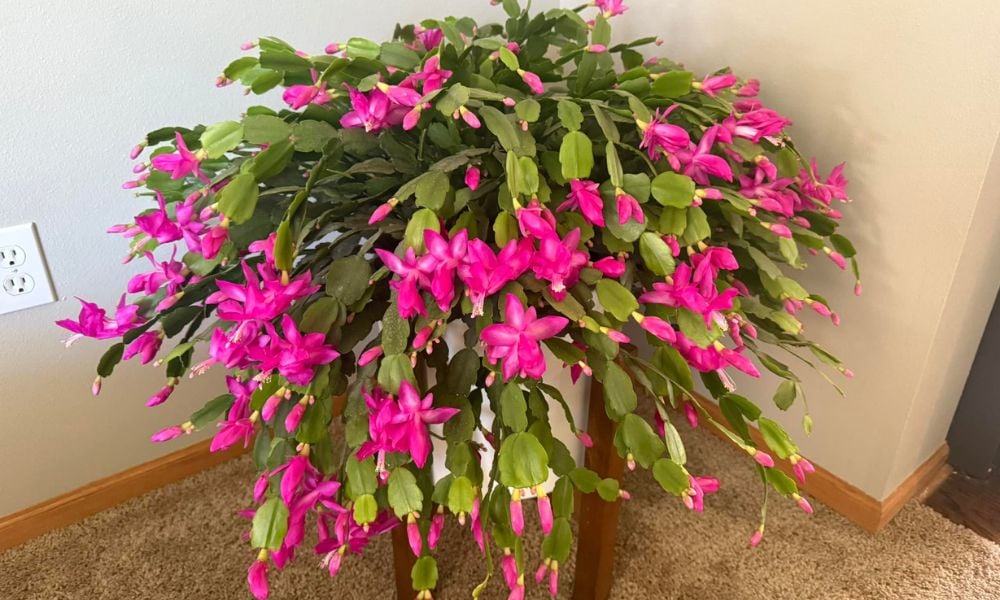
Nothing lifts that holiday spirit quite like its vibrant blooms. Yet, year after year, you might notice your Christmas cactus hesitating to form buds. If you want a healthy plant that overflows with flowers, you’ve got to make sure you feed it regularly and thoroughly.
I’m going to walk you through everything you need to know to pick and use the perfect fertilizer, and we’ll also dig into the ideal conditions your Christmas cactus needs to thrive.
What Conditions Are Necessary for a Christmas Cactus to Bloom?
Before we dive headfirst into the world of fertilizers, let’s unpack the unique nature of the Christmas cactus—you might be surprised to learn that Schlumbergera is actually a succulent.
Despite the fact that folks overseas lovingly call it a “Christmas cactus,” it’s nowhere near as drought-tolerant as its spikier cousins in the cactus family.
It’s actually an epiphytic plant native to the moist forests of Brazil. In its natural habitat, it drapes itself over tropical trees, looking like a fancy decoration straight out of a southern carnival.

Here at home, we’ve trained zigocacti to live in potting mixes—but if we want them to bloom all year long, we need to maintain specific conditions during their growth cycles.
During Blooming:
- Water your Christmas cactus regularly, but always let the soil dry out a bit between waterings—no one likes a soggy basement, right?
- Place the pot in bright, indirect sunlight. Think “window with a curtain,” not “direct sunburn.”
- Try to find a spot on your windowsill where it stays around 59–68°F [15–20°C]; that cool-but-not-freezing range is perfect.
- Keep humidity high—about 50–60% (feel free to mist it; it will thank you).
- Be sure to feed the plant when buds are starting to form.
Oftentimes, people make the mistake of thinking, “Oh, once it’s done flowering, it can fend for itself.” In reality, the old saying “Prepare your sleigh in summer, and your cart in winter” couldn’t be more fitting for Schlumbergera.
How you pamper it during summer and fall directly determines whether you’ll see those buds next season.
Therefore, After Blooming:
- Let your Christmas cactus rest for about 5–6 weeks in a cool room with minimal water and no fertilizer.
- If you haven’t repotted it in 2–3 years, do so in February or March.
- Give it a good “trim,” but resist the urge to cut off more than one-third of the plant—think of it as a haircut, not a buzz cut.
- From April through September, feed it on a regular basis (we’ll talk specifics soon).
- Starting in September, begin shading your zigocactus; to form buds, it needs at least 14 hours of darkness each day for 5–6 weeks.
What to Feed a Christmas Cactus for Lush Blooming
So, unlike most other cacti, the Christmas cactus is an epiphyte. In its tropical, humid homeland, it feeds by sinking its roots into the organic debris that accumulates on tree branches (think leaves, twigs, and bark).
What Nutrients, Then, Should a Fertilizer for Zigocacti Contain?
Without a doubt, a bloom-boosting feed needs to be a balanced mix of the primary nutrients. Usually, that means nitrogen, phosphorus, and potassium—those macro-elements your plant craves in larger amounts.
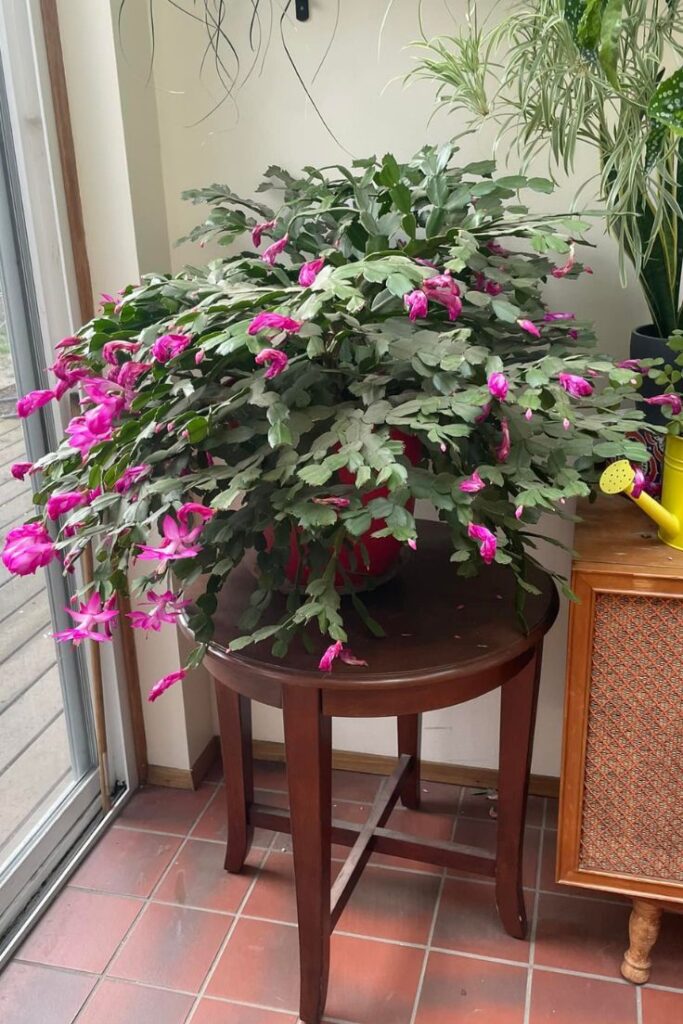
Nitrogen helps build strong, leafy growth; phosphorus powers root development; and potassium is especially critical for bud formation, overall plant health, and stress adaptation.
Magnesium, iron, and calcium are no less important, even though the plant only needs them in smaller doses. Skimp on these, and you’ll see a weakened cactus that’s more susceptible to disease.
Fertilizers come in organic, inorganic (mineral), and organo-mineral varieties. The Christmas cactus doesn’t play favorites—it’ll do well with any of these. Let’s take a closer look at each type:
Feeding with Mineral Fertilizers
When you’re choosing mineral fertilizers, make sure to pay very close attention to the ingredients—after all, Christmas cacti have different nutritional needs than most other plants.
Pick products that are specifically formulated for succulents. Check the N-P-K ratio so you know it’s balanced and appropriate for your plant’s exact growth stage.
If your plant needs a quick pick-me-up to get into top shape in a short period, go for a liquid fertilizer Miracle-Gro Indoor Bloom Booster (Check Price on Amazon).
You can also use it for tons of other plants—poinsettias, kalanchoe, geraniums, and more. For Christmas cacti, it hits the sweet spot: low in nitrogen and high in potassium, plus vitamins and succinic (amber) acid to give that bud-forming process a nice kick.
To make sure you apply fertilizer correctly, follow these steps:
- Prepare your cactus by watering it thoroughly a day or two before feeding. This helps prevent root burn in case you accidentally use the wrong concentration.
- Dilute the fertilizer exactly according to the package instructions (no guessing!).
- Gently pour the diluted fertilizer at the base of the plant, taking care not to let any solution drip onto the leaves.
Feeding with Organic Fertilizers
Organic fertilizers generally come from natural sources. Typical ingredients include:
- Compost
- Manure
- Vermicompost (also called “biogumus” or worm castings)
- Bone meal
All of these organic options provide a slow release of nutrients, giving your plant a steady nutritional base. For an epiphytic succulent like a Christmas cactus, organic additives are huge—because they help improve the substrate’s structure.
But despite the many perks of organics, their biggest downside is that it can be tricky to calculate the right dosage. You also need to be sure your components are free from pests and pathogens.
For houseplants, it’s best to pick tried-and-true products. For example, a fantastic organic boost for your Christmas cactus is a universal bio-active fertilizer based on worm castings (Check Price on Amazon).
This stuff is made from genuine vermicompost—the product of hardworking soil microbes and earthworms—and contains a high percentage of fulvic and humic acids, which help plants overcome stress.
So, both mineral and organic feeding options have their advantages, and in the end, it comes down to your personal preference.
Consider your growing conditions, your plant’s unique needs, and your gardening philosophy. You can even mix and match different fertilizers to give your Christmas cactus the full spectrum of nutrients.
In short, if you want your Christmas cactus to burst into bloom, you can’t skip regular feedings. This beloved plant expends a ton of energy to form those vibrant buds, and it actually starts gearing up as early as summer.
It doesn’t really matter whether you choose an organic or mineral fertilizer—what’s important is that it’s a high-quality product that meets the fundamental needs of these marvelous succulents.
Also, don’t forget about two other key factors: shorter days and cooler temperatures. Usually, Christmas cacti will get sufficient diminishing fall-winter daylight and a chilly windowsill all on their own.
Overall, the Christmas cactus is a pretty undemanding plant, and taking care of it isn’t all that tricky.


