
Rubber plants come in a ton of varieties, and they’re one of the most popular houseplants in the world. They’re super easy for beginners to grow, and if you pop one indoors as part of your décor, it instantly brightens up a room.
But here’s the thing: rubber plants grow like crazy, and if you leave them alone, they’ll get all wild and overgrown.
So in this article, I’m going to break down everything you need to know about pruning your rubber plant—when to prune, how to prune, and what to watch out for.
If you’ve been itching to try growing a rubber plant yourself, this friendly guide should help you out!
What Happens If You Don’t Prune Your Rubber Plant?
Rubber plants include over 800 varieties—like the common Ficus elastica ‘Burgundy’ and each one is an evergreen tree that naturally exceeds 32.8 ft [10 m] in height.
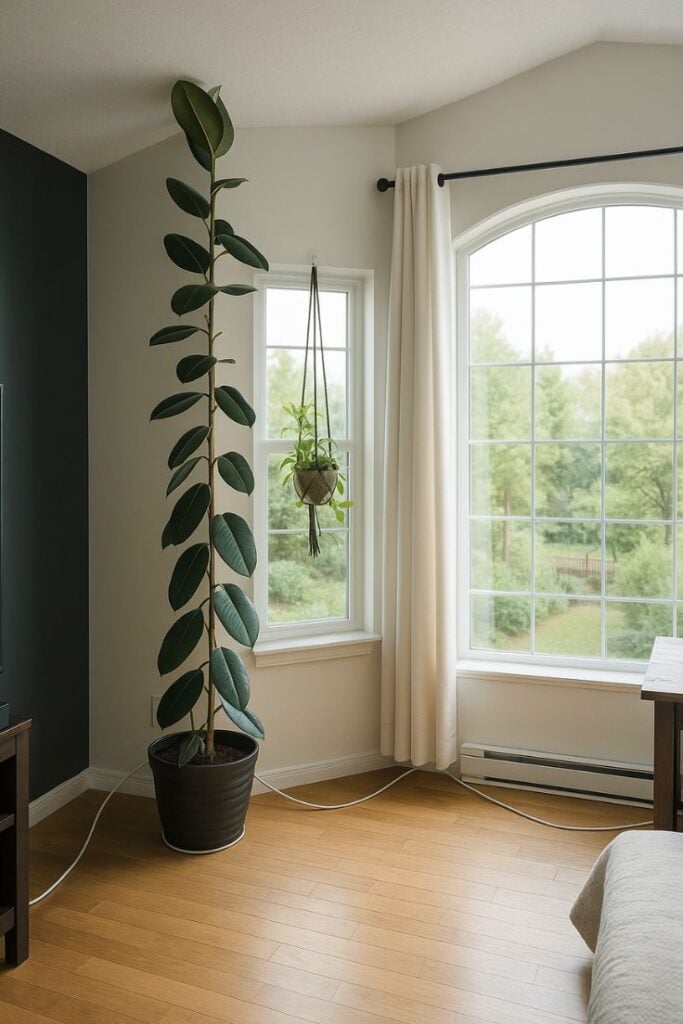
As indoor houseplants, they’re super trendy, but if you don’t prune them, they’ll shoot right up until they’re bumping against your ceiling. Have you ever seen a rubber plant that’s almost too tall for the room? It’s like a leafy skyscraper!
Plus, when the foliage gets too dense, air circulation goes downhill, making it a magnet for pests and diseases.
Regular pruning is key to keeping that beautiful shape and ensuring your plant stays healthy—no one wants a sickly, bug-ridden tree in their living room, right?
When Is the Best Time to Prune Your Rubber Plant?
The optimal windows to prune a rubber plant are from April to June or from September to October. If you prune in the peak of summer, you risk inflicting serious damage, and if you prune in winter, the plant can weaken because it’s not actively growing. So, let’s avoid those extreme seasons!
Also, it’s best to prune on a sunny morning. Why? Because the cut surfaces dry up quickly, which lowers the risk of infection. Think of it like giving your plant a quick “spa day” to heal before any unwelcome pathogens move in.
Pruning Method for Rubber Plants: Where to Cut When It’s Overgrown?

When You’re Just Thinning Out Unnecessary Branches
When you prune a rubber plant, start by thinning out any branches that you don’t need. The golden rule is to cut right at the base (where the branch meets the stem). Here’s what counts as an unnecessary branch:
- Leggy branches (those long shoots with wide gaps between leaves—basically, they’ve stretched themselves out too much)
- Dead branches
- Branches infested with pests or diseases
- Branches that’re growing inward toward the center of the plant
- Branches that droop down toward the ground
- Branches in areas that are too crowded
- “Clustered branches” (when three or more branches split off from the same point)
For example, in the photo above, those cluster branches—called “clustered shoots”—have three or more shoots sprouting from one spot.
Out of those, two are drooping down. So, you’d leave the center shoot, and prune the two side ones right at their base.
When You Need to Shape an Overgrown Rubber Plant
If your rubber plant has grown too much, you can control its shape with a method called “hard pruning,” which involves cutting the branches partway down. In hard pruning, you cut about 0.8–1.2 in [2–3 cm] above the growth point.
The growth point of a rubber plant is the part that bulges out from the trunk or branch. If you prune there, it won’t grow any taller, and new shoots will emerge from the growth points just below the cut.
At that time, it’s important to carefully determine exactly where the growth points are on the trunk or branches. Prune just above the growth point that faces the direction you want your plant to grow.
Things to Watch Out for When Pruning Your Rubber Plant
When pruning a rubber plant, keep the following three points in mind:
- Be careful to prevent disease from entering through the cut surface.
- Use clean pruning shears or a saw.
- Avoid direct contact with the white sap.
It’s especially important to keep bacteria and other pathogens from entering through the cut. If you cut a thick branch, it’s reassuring to apply a commercial wound‐sealing agent.
Also, rubber plant sap is very irritating, so some people may develop a rash. To prevent skin irritation, it’s a good idea to wear gloves when pruning a rubber plant.
Care After Pruning Your Rubber Plant
After pruning your rubber plant, care for it in a bright, shaded spot or partial shade, just like you normally would. If it’s in a pot, give it a thorough watering whenever the soil dries out.
Give it fertilizer once a month during its growing season, which is late May through September.
Also, after pruning, you can enjoy beautiful curves by “training” the plant with bends. If you have a variety with flexible branches and trunk, you can create a natural curve by bending the trunk by hand several times.
Using wire lets you shape it into whichever curve you like—just attach the wire to the trunk, and remove it after about one week.
If Your Rubber Plant Grows Too Much, Prune and Shape It!
Rubber plants grow fast, so if you leave them alone, their leaves will keep getting denser and denser.
To keep your rubber plant well‐maintained, regular pruning is a must. Pruning a rubber plant isn’t difficult, so when the time is right, give it a try!


