I know how confusing it can feel when you’re trying to tell these two beautiful bulbs apart. Even seasoned gardeners can mix them up! Both belong to the Amaryllis family, yet they hail from different regions and show unique traits in blooming times, bulb shape, and much more.
But once you learn the key distinctions, you’ll feel more confident in choosing the right plant and giving it the care it deserves.
For a long time, Amaryllis (commonly known in the U.S. as the Belladonna Lily) was represented by just one species—Amaryllis belladonna. On the other hand, Hippeastrum (often simply called Amaryllis in the U.S.) boasts over ninety species. Adding to the confusion, some Hippeastrum varieties include the word “Amaryllis” in their names.
Which One Is It: Amaryllis or Hippeastrum?
If you want to correctly classify these bulbs, focus on a few key features. Although they look alike at first glance, they differ in species count, bulb shape, leaf formation, blooming season, and fragrance. Check out the table below to clear up the mystery:

Key Traits Comparison
| Trait | Amaryllis (Belladonna Lily) | Hippeastrum (Commonly Called Amaryllis in the U.S.) |
| Species Count | 1 | About 90 |
| Bulb Shape | Pear-shaped, elongated; fine, hairlike fibers under scales | Round, slightly elongated; smooth white scales |
| Leaf Shape | Narrow | Wide, strap-like |
| Leaf Emergence | After flowering | Along with the flower stalk |
| Blooming Time | Late summer to early fall (in South Africa, it’s spring) | Winter to early spring; large bulbs may bloom twice a year |
| Number of Flowers | Up to 12 per stalk | 2 to 6 per stalk |
| Fragrance | Delicate scent during bloom | Flowers have no fragrance |
Both flowers belong to the same family, so their general care is similar. When growing Amaryllis at home, you’ve got to follow proper techniques so it blooms annually. The same goes for Hippeastrum—good care equals reliable flowering.
Exploring the Elegant Amaryllis (Belladonna Lily)
The Amaryllis we know and love, Amaryllis belladonna, is native to South Africa. It reached Europe first, and since Hippeastrum was discovered later, early botanists mistakenly considered Hippeastrum to be a South American type of Amaryllis. Only their inability to cross-breed proved that these were entirely different genera.
This Belladonna Lily grows from a bulb and sends up a sturdy flower stalk that can reach about 24 inches (60 cm) tall. Each stalk can host 2 to 12 funnel-shaped blossoms around 2.5 to 4 inches (6–10 cm) in diameter. By the time the flower stalk emerges, most of the leaves have died back.
Its bulb is pear-shaped, covered in grayish scales, and measures about 2 to 4 inches (5–10 cm) across. Old and new scales connect with thread-like fibers that look like spiderwebs.
Amaryllis typically blooms in late summer to early fall (which corresponds to spring in its native South Africa). Its flowers release a lovely fragrance.
Introducing the American “Knight’s Star” (Hippeastrum)
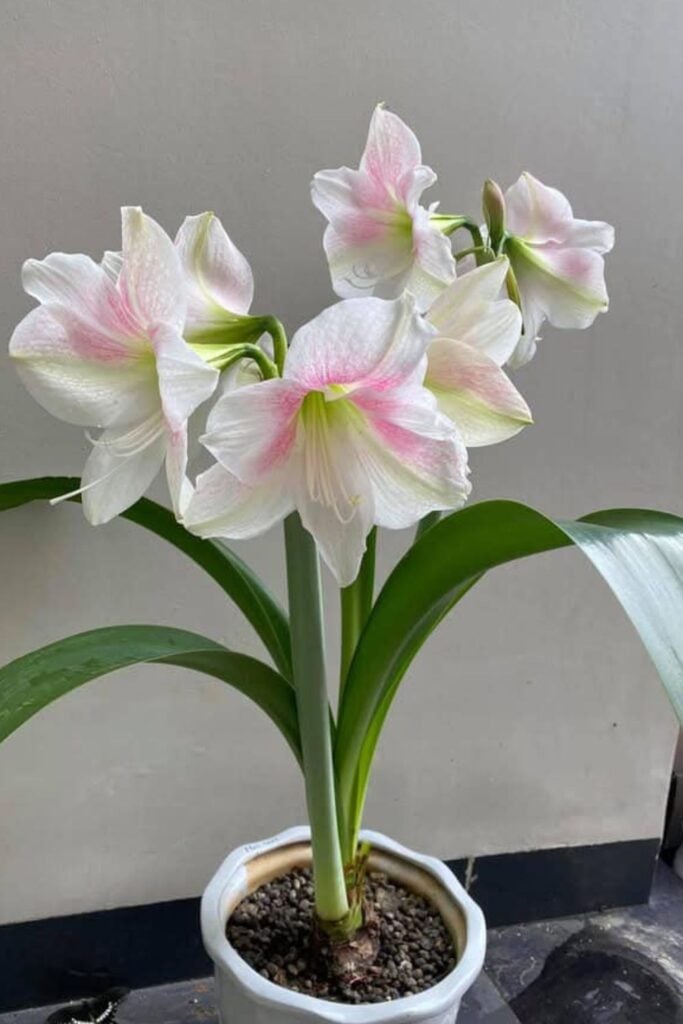
Hippeastrum earned the nickname “Knight’s Star” because of its dramatic, star-shaped blooms. It also belongs to the bulb family. But there are differences: Its hollow stalk is taller, and its flowers are larger—some varieties reach about 10 inches (25 cm) wide.
Hippeastrum first grows its leaves, followed by a flower stalk with 2 to 4 buds. One leaf often serves as a base for the bloom. The bulb is usually round or slightly elongated, with white, onion-like scales.
Hippeastrum blooms from winter to early spring, and unlike Amaryllis, its flowers have no fragrance.
7 Notable Differences Between Amaryllis and Hippeastrum
When you set both plants side by side, the differences stand out. But when viewed separately, it’s all too easy to get confused. Let’s break down the seven key differences, so you’ll never mix them up again.
1. Different Origins
Even though both are part of the Amaryllis family, they come from separate continents and different genera. Amaryllis (Belladonna Lily) hails from South Africa and is almost the sole member of its genus. Hippeastrum, on the other hand, has over 90 species, most found in the Amazon basin in South America.
2. Distinct Blooming Seasons
Their origins shape their blooming times. If you see your bulb flowering in fall, you’ve likely got an Amaryllis (Belladonna Lily).
Hippeastrum typically blooms in winter to early spring. Of course, if you’re buying a potted plant from a nursery, forced blooms can occur anytime, making it trickier to be certain.
3. Unique Bulb Structure
Amaryllis bulbs are smooth, pear-shaped, and grayish, with a subtle, web-like interior. They often produce “baby” bulbs. Hippeastrum bulbs are rounder or slightly elongated and white, resembling onion scales. They produce fewer offsets.
4. Flower Stalk Differences
Hippeastrum sports a hollow flower stalk that can shoot up to about 39 inches (1 m). Amaryllis has a dense, solid stalk, about 24 inches (60 cm) at most. This difference affects both the bloom size and the number of blossoms they can support.
5. Leaf Timing
Amaryllis leaves wither away by the time it blooms. They usually appear in late fall or spring and dry up with summer’s heat.
Hippeastrum, however, keeps its leaves during flowering—three at the base and a fourth that props up the blooms. Forced Hippeastrum can sometimes bloom leaf-free, which adds to the confusion.
6. Flower Appearance and Fragrance
Amaryllis may show off up to a dozen blossoms on one stalk, but they’re smaller, about 2.5 to 4 inches (6–10 cm) in diameter. Hippeastrum can’t hold as many, usually 2 to 4 larger flowers per stalk, some reaching 10 inches (25 cm) wide.
Hippeastrum also offers a richer variety of colors, including two-tone and multi-hued options, while Amaryllis sticks to white, pink, red, and purple shades. Scent is another clue: Amaryllis flowers smell delightful, while Hippeastrum blossoms are scent-free.
7. Seed Germination Times
Both can reproduce by seed, but germination rates differ. Hippeastrum seeds sprout in about two weeks, while Amaryllis seeds need at least eight weeks to emerge. This difference might not be top-of-mind for casual growers, but if you’re starting from scratch, it’s good to know.
You can find other subtle differences too, such as stem color, bulb structure nuances, and scale color. But I hope these key points help you feel more confident. After all, Amaryllis is much less common in home gardens than Hippeastrum.
Now that you know what sets them apart, you’ll be ready to pick the right plant and give it the special care it deserves. Don’t wait—use these insights now to ensure your bulbs thrive and delight you with their gorgeous blooms!