For your Christmas cactus, you can prepare ready-made soil from turf soil, leaf mold, humus, peat, coarse sand, and perlite in a ratio of 1:6:4:2:2:0.5. Mix the components with a trowel in a large container, pour the resulting substrate into a deep baking pan, lightly moisten it, and place it in an oven heated to about 176 °F [80 °C].
You can also use specialty materials sold in garden centers, such as pebbles, drainage expanded clay, gravel, or ground sphagnum.
Few people realize that Christmas Cactus is quite picky about the soil it grows in. If a grower approaches substrate preparation carelessly, the Christmas cactus is unlikely to reward them with a lush, long-lasting bloom.
What kind of soil does a Christmas cactus need? How do you prepare it? This article aims to answer those questions.
What Soils Does Christmas Cactus Grow Naturally?
The Christmas cactus is an epiphytic cactus growing in the tropical forests of South America. It lives on fallen logs, stumps, tree trunks, and the areas around them.
All the nutrients it needs for full development come from trees and nearby plants. Tropical forest soil is loose and light thanks to the constant decay of leaves and plant matter.
Recommended Soil Composition for Home Christmas Cacti
Your Christmas cactus’s substrate should mimic its natural environment as closely as possible. It needs to be loose, light, well-draining, nutrient-rich, and allow water and air to pass through easily.
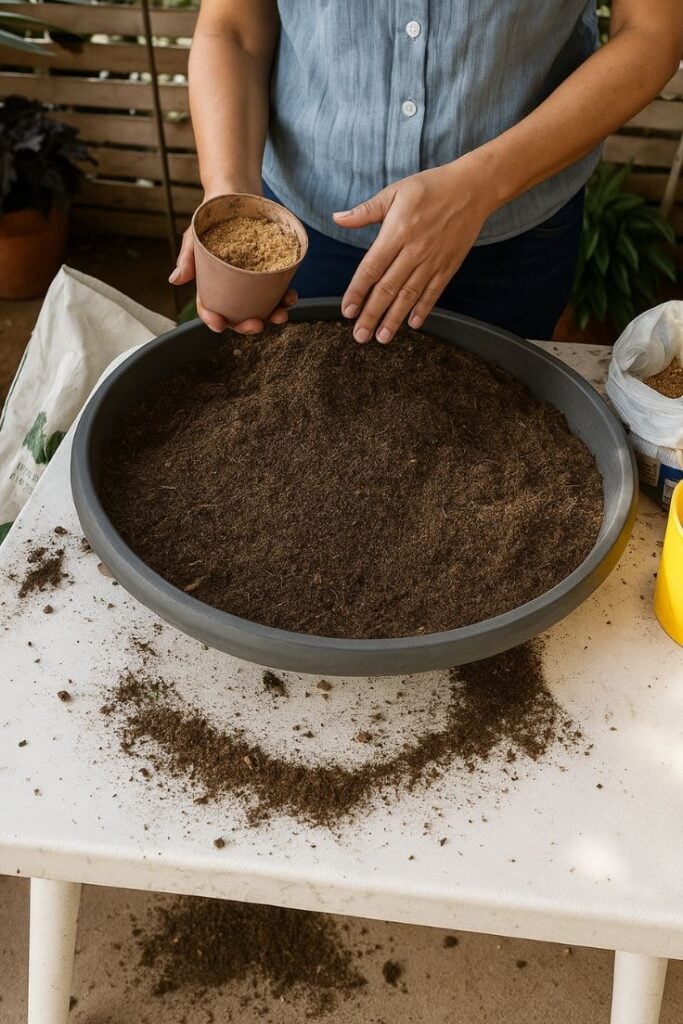
The components can include moss, decayed leaves, and bark. The soil should also be slightly acidic (pH 5.5–6).
There are many possible mixes for planting Christmas cacti, but every good recipe must include four components:
- Base Soil: turf soil, garden soil, leaf mold
- Aerator: peat, coarse river sand, perlite, vermiculite, sphagnum moss, pieces of bark, fresh sawdust
- Fertilizers: humus, turf, compost, worm castings, mineral fertilizers (potassium-phosphorus)
- Drainage: expanded clay pellets, gravel, pebbles, brick chips, crushed stone, or even foam-glass granules. Place a drainage layer at the bottom of the pot (about one-third of the pot’s height) and you can mix a little into the substrate itself.
Homemade Mix vs. Store-Bought: Which Is Better?
Both homemade and store-bought substrates work well for Christmas cactus. It just comes down to whether you have the extra cash to buy a specialty mix or the free time to make your own.
Store-bought mix pros: fully ready to use—no thermal treatment or fungicide dips needed.
Homemade mix pros: tailor the proportions exactly to your plant’s needs. Many experienced gardeners swear by DIY soil for the best bloom results.
Which Ready-Made Mixes Are Suitable?
In a garden center, you’ll find cactus mix or universal potting mix. Although the Christmas cactus is a cactus, the nutrient-poor succulent mix won’t suit it as well as the universal mix. However, cactus soil does offer key qualities:

- loose texture
- air and moisture permeability
- correct acidity level
Professionals recommend mixing cactus soil and universal potting mix 1:1 for best results.
When choosing, check the expiration date, ingredient list, moisture level, fibrous texture, and presence of aerating components.
How to Prepare Soil Yourself
For Mature Plants
- Gather all components in separate containers: 6 parts leaf mold soil, 1 part turf soil, 4 parts humus soil, 2 parts peat, 2 parts sand, and a little perlite or another aerator (no more than 10 % of total volume).
- Prepare a large mixing container.
- Have a measuring cup, trowel, and gloves ready.
- Wearing gloves, measure out each component.
- Pour everything into the large container and mix thoroughly with the trowel.
- Spread the soil on a baking pan to a depth of up to 2 in [5 cm] and moisten it.
- Place the pan in an oven preheated to 158 °F–194 °F [70 °C–90 °C] for at least 30 minutes to sterilize.
For Young Christmas Cacti
- For young plants, the mix should be even lighter and looser, so increase the proportion of aerators.
- Prepare a large container, trowel, gloves, and measuring cup. Dry all ingredients beforehand.
- Wearing gloves, mix: 2 parts compost soil, 1 part river sand, 2 parts peat, plus 3 % each of fresh sawdust, bark pieces, perlite, vermiculite, and sphagnum moss.
- Transfer the mix to a fine-mesh sieve and rinse it with a fungicide solution or a bright pink potassium permanganate solution.
What Kind of Pot Does a Christmas Cactus Need?
When choosing a pot, the main rule is that it should be shallow but wide, because the Christmas cactus’s roots stay in the topsoil layers.
Avoid deep, bulky pots—if roots spend too much energy filling a large volume, there’s less left for blooming.
Material choice:
- Clay pots: eco-friendly, non-toxic, absorb moisture, allow air exchange.
- Plastic pots: maintain stable temperatures, though they don’t breathe.
Whatever you choose, a light-colored pot will keep the soil cooler, and drainage holes are an absolute must.
When Should You Change the Soil?
To keep your Christmas cactus growing vigorously and blooming abundantly, change the soil periodically.
Young plants are usually repotted every year; mature plants, every 3 years; very large specimens, every 5 years.
Also, change the soil immediately after purchasing a new cactus. Nursery substrate is meant for transport, not long-term growth, and contains no nutrients—leaving your plant at risk.
Always repot if your cactus shows signs of fungal infection (Fusarium, Pythium, Phytophthora).
In such cases, transfer the plant to fresh soil and treat the roots and foliage with an appropriate fungicide.
Planting Guidelines
- Fill the bottom third of the pot with a drainage layer.
- Add at least 0.4 in [1 cm] of substrate on top.
- Place the Christmas cactus in the center, gently spread its roots, and cover with soil.
- Firm the top layer lightly to secure the plant.
- Do not water for 3–4 days; keep in partial shade for 2 weeks. After this adaptation period, resume normal care.
Light, loose, nutrient-rich soil is crucial: with the right mix, your Christmas cactus will thrive and shower you with blooms.