
When you give hydrangeas regular, proper care—which is simpler than it might seem—they reward you with spectacular blooms in big, rounded or conical clusters.
If your hydrangea refuses to bloom, you may need to adjust its growing conditions. I’ve tackled the most common questions about caring for hydrangeas both outdoors and indoors, and I’m excited to share the answers with you.

1- Choosing the Right Spot: Planting Hydrangeas with Ease
Most hydrangea varieties do best when planted in early spring. However, for types with a well-established root system—like panicle hydrangeas (Hydrangea paniculata) or smooth hydrangeas (Hydrangea arborescens)—you can also plant them in early fall (around September).
Pick a spot in your garden that’s protected from strong winds and gets ample light but isn’t blasted by direct midday sun. That intense sun can stress hydrangeas, so a location with morning sun and afternoon shade is perfect.
Also, try to avoid planting them too close to other large, dominant plants. Hydrangeas develop the best shape and branches when they’re planted solo and have space to spread.
Keep in mind that tall hydrangea stems with large flower heads get heavy and can bend over after rain. If you plant your hydrangeas next to a narrow walkway, they might droop and block the path.
Hydrangeas prefer loose, fertile soil that’s slightly to moderately acidic and drains well. A good option is an equal mix of leafy soil, regular garden soil, sand, and peat.
If your soil is more alkaline, hydrangeas can suffer from chlorosis. In that case, enrich the planting hole with peat moss or pine sawdust ahead of time.
When planting, make sure the top of the root ball (the “root neck”) is at ground level. Water thoroughly, then mulch the area around the trunk with a 2–3 in (5–7 cm) layer of sawdust or peat.
2- Mastering Watering Techniques for Healthier Hydrangeas
The botanical name “Hydrangea” comes from Greek and translates to “vessel of water”—and there’s a good reason for that.
Hydrangeas are thirsty plants that wilt when the soil dries out, yet they don’t like standing water, either. The key is to keep the soil consistently, moderately moist at the entire depth of the root zone.
In a typical mild U.S. summer, I recommend giving a mature hydrangea about 5 gallons of water once a week. If your weather runs hotter and drier, water twice weekly instead.
You’ll also want to avoid drastic swings between too dry and very wet soil. In other words, try not to wait until your hydrangeas are severely parched before dousing them with a huge amount of water.
3- Fertilizing Strategies to Maximize Hydrangea Blooms
If you’re dreaming of lush, abundant hydrangea blooms, you absolutely need to feed your plants. Here’s how I handle it:
- Spring Feeding (after the last frost): Use a balanced, specialized commercial fertilizer that’s widely available in the U.S., such as
Miracle-Gro Water Soluble All Purpose Plant Food on Amazon or
Espoma Organic Plant Food on Amazon.
Alternatively, you can mix your own blend by combining about 1–1.4 oz (30–40 g) of superphosphate, 0.7–0.9 oz (20–25 g) of ammonium sulfate or urea, and 1.1–1.2 oz (30–35 g) of potassium sulfate per plant.
If you live in a cooler climate, you can boost hydrangea resilience by spraying young leaves with a growth stimulant like Superthrive on Amazon. - Second Feeding (at the start of budding): Aim for 2.1–2.8 oz (60–80 g) of superphosphate and 1.4–1.6 oz (40–45 g) of potassium sulfate per plant.
- End-of-Summer/Early Fall Treat: In late summer or early fall, I give each hydrangea around 33–44 lb (15–20 kg) of compost or well-rotted manure. It’s a wonderful way to replenish the soil and prepare them for the next growing season.
4. How to Switch Hydrangea Blooms: Pink, Blue, or Mixed
Bigleaf hydrangeas are especially beloved by gardeners for one surprising trick—they’re real “chameleons”! In other words, you can change your hydrangea’s bloom color from pink to blue or the other way around (and switching from pink to blue is generally easier).
However, if you have a white bigleaf hydrangea variety, no amount of coaxing will make it change color. Only pink or blue hydrangeas are up for a makeover!
Don’t believe it? Here’s the secret: to get blue blooms, you need acidic soil, accessible aluminum salts (they produce the blue pigment), and very little phosphorus (because it binds aluminum). For pink blooms, you’ll want neutral to alkaline soil with aluminum salts out of reach.
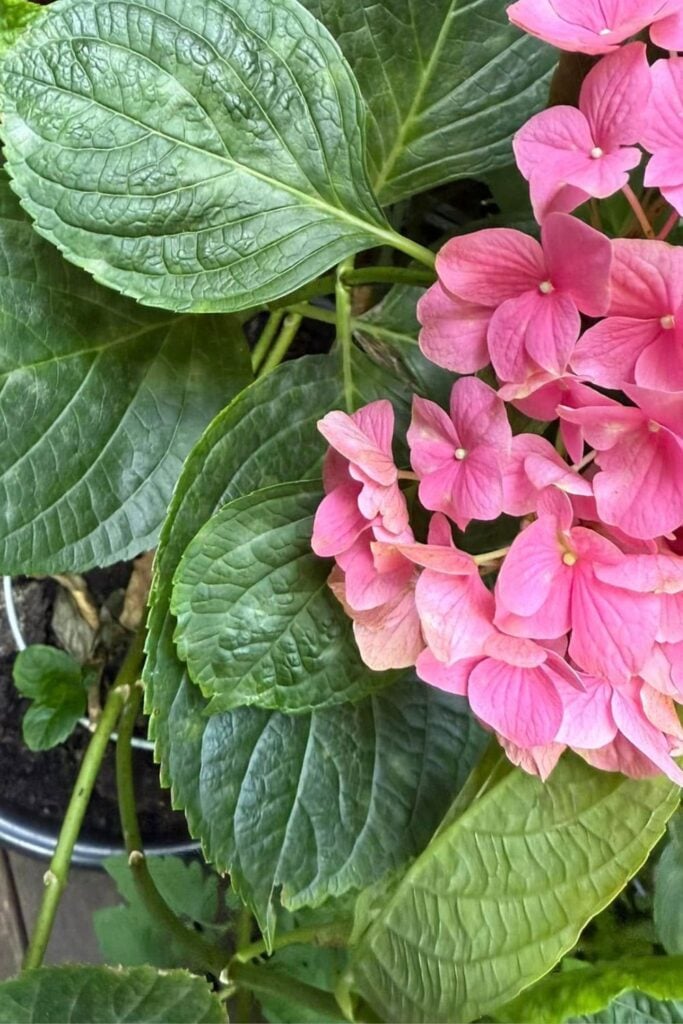
Simple Steps to Get Pink Blooms
- Monitor Soil pH
Keep the soil pH at 6.0 or higher (ideally 6.0–6.2). - Neutralize Excess Acidity
If the soil is too acidic, apply neutralizing additives a few times a year, such as garden lime, chalk, dolomitic lime, or ground limestone. - Choose the Right Fertilizer
Use fertilizers with relatively high phosphorus and nitrogen but low potassium. One option is a monoammonium phosphate formula you can find on Amazon, like
JR Peters 52024 Jack’s Classic Blossom Booster. - Consider Container Growing
If neutralizing your entire garden bed is tough (especially if you have acid-loving plants in the same area), try growing pink hydrangeas in large pots. Also, avoid any potting mix with aluminum-containing components like clay or expanded clay (leca). - Add a Mild Manganese Solution
Use a weak solution of potassium permanganate (if available) in your watering routine. You only need a small amount, and it helps maintain a slightly more alkaline environment.
Simple Steps to Get Blue Blooms

- Keep Soil pH Below 5.5
Regularly check your soil’s acidity. If it’s too alkaline, acidify it by mixing in orange-colored peat moss, shredded pine bark, or a pinch of citric acid. - Boost Aluminum
Enrich the soil with aluminum-containing additives, such as clay or aluminum sulfate (available in most garden centers and on Amazon as Bonide Aluminum Sulfate. - Watch Out for Alkaline Influences
Avoid planting hydrangeas too close to concrete paths, rock gardens, or limestone walls—these leach materials that increase soil pH. - Low-Phosphorus, High-Potassium Fertilizer
Choose fertilizers that are lower in phosphorus, higher in potassium, and moderate in nitrogen, like certain balanced products you can find on Amazon: Miracle-Gro Shake ‘n Feed All Purpose Plant Food.
Skip superphosphate or bone meal because they raise phosphorus levels. - Check Your Water
Make sure the water you use for irrigation doesn’t add calcium. Ideally, keep your water’s pH at 5.6 or lower. - Add a Mild Alum or Iron Solution
Occasionally, use a weak solution of ammonium-potassium alum or iron sulfate (widely available in garden stores, also sold as (Southern Ag Ferrous Sulfate) to help maintain acidity and boost blue pigments.
Enjoy Multicolored Blooms
Believe it or not, you can even get different-colored blooms on the same plant! Simply fertilize and water different sections of the root zone with different solutions, or just treat one side.
More often than not, hydrangeas grown outdoors end up producing a gorgeous range of shades—from pale pink all the way to purple or bright blue—because it’s nearly impossible to ensure every part of the plant gets exactly the same nutrients at the same time. So get ready for a rainbow of color!
A word of caution: don’t overdo it when trying to raise your soil pH. Once it goes above 6.5, there’s a real risk of iron deficiency and plant chlorosis.
5. Essential Pruning Advice: Timing and Techniques
Do hydrangeas actually need pruning? Technically, they’ll survive just fine without it. However, gardeners who want a neat, well-shaped plant will tell you it’s important. Here’s what I do:
- Age Matters
You can leave a young hydrangea alone for the first 2–3 years. After that, it’s a good idea to start shaping it. - Best Time to Prune
Prune annually in early spring, before the sap starts flowing. Each hydrangea type has its own specifics:- Bigleaf Hydrangea (Hydrangea macrophylla)
Stick to sanitary pruning: remove all frost-damaged, broken, or overcrowded branches. - Smooth Hydrangea (Hydrangea arborescens)
Remove weak or crooked shoots at the base, along with any branches that are three years old or older. Heavily shorten the year’s new growth, leaving only a few buds. The weaker the shoot, the harder you cut it back. - Panicle Hydrangea (Hydrangea paniculata)
Prune more gently. Remove any branches growing inward toward the center, and trim new growth down to 1–3 pairs of buds.
- Bigleaf Hydrangea (Hydrangea macrophylla)
- Light Fall Trim
For any type of hydrangea, a light fall pruning is also helpful. Snip off dried flower heads and any overly long shoots that might break under winter snow.
6. Growing Hydrangeas in Containers: Potential Challenges
No backyard? No problem! If you still want to enjoy glorious hydrangea blooms, it’s totally possible to grow them indoors.
If you’ve read the tips above, you’re already in great shape. Caring for a hydrangea inside isn’t much different from tending it in the garden.
- Choosing a Variety
Bigleaf hydrangea (Hydrangea macrophylla) is the usual pick for indoor growing. In a home environment, the plants stay more compact but often deliver intense bloom colors—burgundy-red, bright blue, cream, and more. - Size and Potting
With proper care, an indoor bigleaf hydrangea can grow up to about 3 ft [1 m] tall, boasting flower clusters up to 12 in [30 cm] across. You’ll need a roomy container of about 2–4 gallons [8–15 L]. - Potting Mix
Use equal parts garden soil, peat moss, and half-decomposed conifer litter (or another acidic material). - Indoor Conditions
Hydrangeas do best in a bright, cool area without direct sunlight. They love fresh, slightly humid air without drafts or sudden temperature changes. Water thoroughly and often with soft, dechlorinated water at room temperature. - Fertilizing
Throughout summer—about five or six times at two-week intervals—feed your hydrangea a balanced mineral fertilizer. For example, mix 0.1 oz [3 g] of potassium sulfate, 0.14 oz [4 g] of superphosphate, and 0.1 oz [3 g] of ammonium nitrate per 1 quart [1 L] of water. You can also look for ready-made indoor plant foods on Amazon like Miracle-Gro Indoor Plant Food. - Winter Rest Period
Even indoors, hydrangeas behave like deciduous shrubs, dropping their leaves for winter. This downtime is crucial. Gently tie the stems together and move the pot to a shaded, cool spot, making sure to keep the soil slightly moist. In late winter to early spring (around February–March), bring the plant back into its usual indoor location and resume normal care.
Hydrangeas are a fabulous choice whether you’re decorating a cozy apartment or sprucing up a spacious yard.
Follow these simple tips for regular care, and trust me—you’ll be rewarded with a breathtaking display of lush, colorful blooms. If you’ve been hesitant, now’s the time to dive in. Don’t wait to experience the joy of these stunning flowers!


